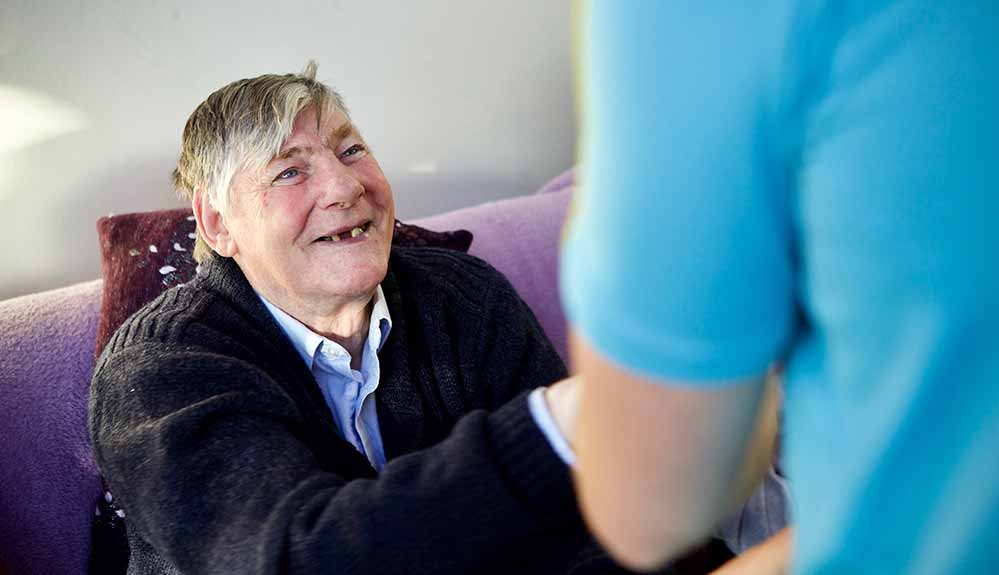
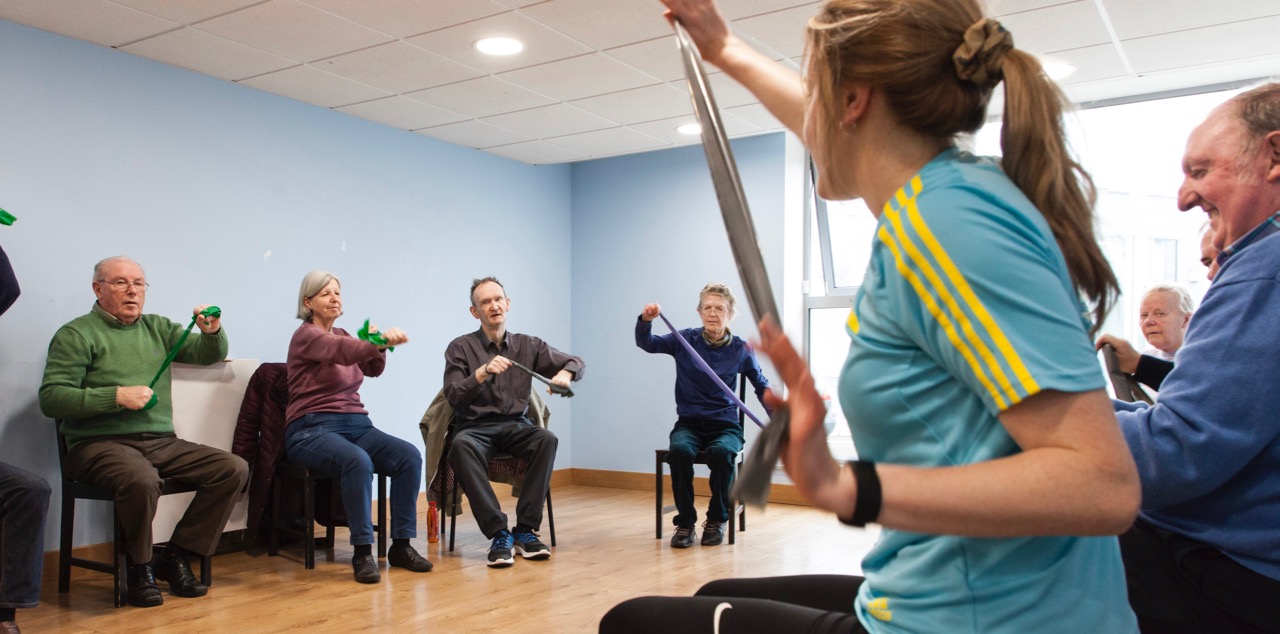
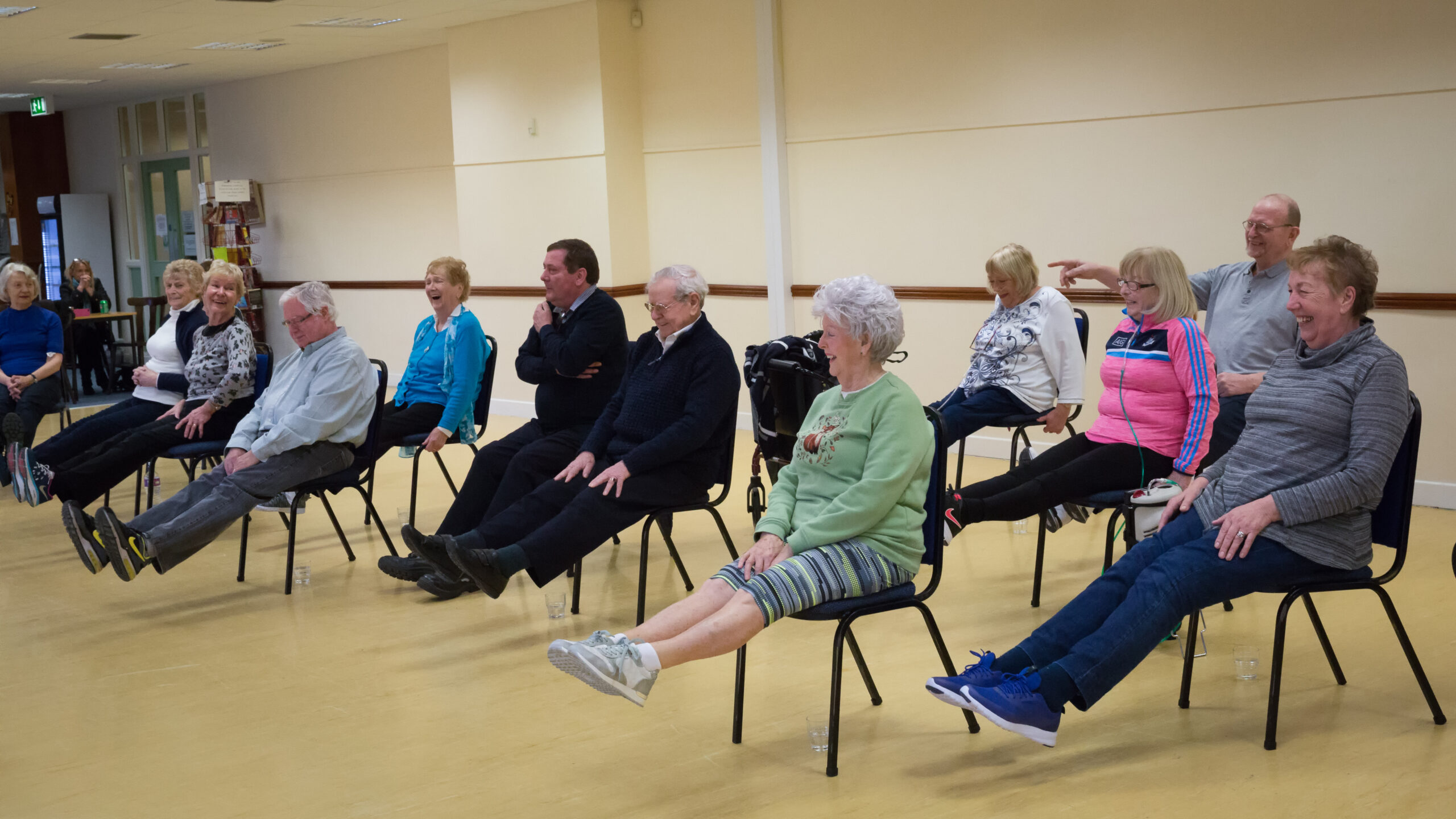
Seated exercise for older adults does not always get the credit it deserves. At Siel Bleu at Home, our Seated Circuit class proves just how effective it can be.
What is our seated circuit Class?
Seated Circuit is a full-body workout delivered entirely from a chair. It combines strength, aerobic, and mobility exercises, working through each in a structured circuit format. Weights can be used in the class for those who would like to include them. The result is a session that targets your whole body and keeps you moving from start to finish.
Who is seated exercise for older adults for?
Seated Circuit is for anyone who wants an effective, low-impact workout. Whether you are returning to exercise after a break, managing a health condition, or just looking for a class that works your whole body from a comfortable position, Seated Circuit is a great option.
Benefits of seated exercise for older adults
The benefits of seated exercise go beyond what most people expect. Regular participation can help build and maintain muscle strength, support cardiovascular health, and help with balance and coordination. For older adults in particular, maintaining strength and balance has a direct impact on independence and quality of life.
Because the class is low impact, it is also kind to your joints. That means you can stay active and keep moving without putting unnecessary strain on your body.
Give it a go
Seated Circuit is also part of a bigger picture: Siel Bleu at Home is a live, connected community of people showing up for each other every week. Seated Circuit runs as a part of the Siel Bleu at Home timetable, with classes available Monday through Friday. You can book your spot through the timetable on our website or download the GloFox app to manage your classes on the go. Once you book, you will receive a Zoom link by email to join the live session. If you cannot make it live, the class is available to watch back for up to two weeks.
For any questions get in touch at sielbleuathome@sielbleu.ie.
This is our fifth and last part of the Functional Resistance Training series, and in this episode, we will be discussing the Hell Raise. If there is a chance you haven’t read the previous episodes, you can check them out on our blog.
Heel Raise
This is an important exercise promoting balance and lower extremity/knee stability and can be performed both as a muscle-strengthening activity and a balance exercise. The muscle group we are working here is the calf muscles.
How to Perform Heel Raises:
Stand with feet flat on the floor, and to begin the movement raise the heels to the maximum height possible, make sure to lift heels off the floor for each repetition. We are aiming for around 12 to 15 repetitions, remember not to worry if we cannot get all 15 reps on the first try. Start at your level and build up to 3 sets of 12-15 reps.
Progressions:
Level 1: Face a counter or a wall and places the hands-on either to help with the balance. Lift heels off the floor, hold for 2 – 3 seconds, and return to the start position (flat foot)
Level 2: Hoover the hands at the wall or over the counter but do not touch the counter/wall, hold each rep for 2-3 seconds and return to start position.
Level 3: Single leg heel raise, lift one leg and perform heel raises on one leg as shown in the pictures, then switch to the other.
The Information in the above blog has been adopted from Roetert & Ortega (2019) “Physical Literacy for the Older Adult” published in the Strength & Conditioning Journal.
This is the fourth and our second to last post of the Functional Resistance Training series. In this episode, we will be discussing the Carioca Step. Read back the previous episodes to find out more about Shoulder Retractions, The Bridge and the Partial Squat.
Carioca Step
The focus of this exercise is to develop agility and stability and it involves a cross-over step to maintain coordination. This exercise is recommended for older adults already moderately active and not inactive seniors with poor strength and balance, as the activity requires greater skill (strength & balance) to perform. The adequate base of strength and balance/stability should be developed first, and it is recommended to perform the exercise under close supervision/guidance.
How to perform the Carioca Step
Stand facing forwards and move the right leg forward and place it in front of the left foot and across the body on the floor. Take the left foot from behind and place it next to the right. Repeat, performing a weave to move 5 steps in one direction. Then do the same, taking the left foot forward and across the right leg on the floor. Move the right leg out from behind and next to the left, weaving across the floor.
Progressions:
Level 1: Perform the exercise facing a counter with hands placed on the counter for support.
Level 2: Perform the exercise facing the counter, with hand above the counter but not touching the counter.
Level 3: Perform the exercise in an open space and increase speed to increase the difficulty.
The Information in the above blog has been adopted from Roetert & Ortega (2019) “Physical Literacy for the Older Adult” published in the Strength & Conditioning Journal.
We are now on the third episode of our Functional Resistance Exercises series and we will be discussing the Partial Squat. If you haven’t already, please read through our previous two posts on Shoulder Retraction and The Bridge exercises.
Partial Squat
This is the one exercise that we use daily in our lives, whether it is to sit down on a couch to watch our favourite show, or to sit down to have a cup of tea and a few biscuits, or doing other tasks such as using the toilet, standing up on a bus etc. Being able to squat down and up has a huge impact on improving our dependency and quality and enjoyment of life. Performing this exercise daily will have positive impacts on balance and posture, therefore reducing the risk of falling, which in turn builds confidence while standing and walking.
How to perform the Partial Squat
Stand with the feet shoulder-width apart with a chair placed behind, and a table or chair in front for balance. Push the hips back and bend the knees to descend slowly, keeping an upright posture. Based on ability, bend 20-30° or ¼ of the way. Pause for 2 to 3 seconds and return to the starting position.
Progressions:
Level 1: Perform the exercise as described above and focus on the posture throughout the movement.
Level 2: Same exercise without the use of a chair for balance and support.
Level 3: Holding weights (dumbbells) in each hand can further increase difficulty.
The Information in the above blog has been adopted from Roetert & Ortega (2019) “Physical Literacy for the Older Adult” published in the Strength & Conditioning Journal
This is the second blog post discussing the Functional Resistance Exercises. If you haven’t already, please check out the previous post explaining the Scapular Retraction exercise. If you have done so already, let’s dig into the benefits of the Bridge and how to perform it.
The Bridge
Have you ever found yourself lying on the bed, couch or even worse laying on the ground after falling and not being able to get up? To avoid such situations, we need to strengthen the muscles responsible for getting us up, these muscles make up the “posterior chain” (low back, hip extensors, gluteal muscles and hamstrings). The mentioned muscles provide the strength, support and control to raise the hips from the floor, bed or a couch from a supine position (laying on your back). Strengthening these muscles provide significant benefits related to balance, posture and particularly core strength.
How to perform the Bridge:
We’ll start by laying on your back on a firm surface such as an exercise mat or padded floor. From this position we are going to bend the knees we are going to raise the hips toward the ceiling, bringing them in line with the knees and shoulders. The focus is on pushing the feet into the ground while lifting the pelvis. Arms should be kept at the side with palms facing down which will provide stability and shoulders remain on the surface to protect the neck.
Difficulty:
Level 1: Lie down on your back with soles of the feet on the floor and knees bent at approximately 90° and raise the hips upward to the ceiling. Press your feet into the ground while lifting the pelvis to bring hips in alignment with the knees and shoulders. Hold the position for 2-3 seconds, then slowly return to the starting position.
Level 2: While in the “up” position, extend one leg at the knee to bring in alignment with the hips, making sure the pelvis remains level. Do not let one side “drop” or lower when extending the leg. Hold for 2-3 seconds.
*Remember we are aiming for 3 sets of 12-15 reps, and it is okay to start with just a couple of reps. Don’t discourage yourself and let’s build-up to 15 reps!
The Information in the above blog has been adopted from Roetert & Ortega (2019) “Physical Literacy for the Older Adult” published in the Strength & Conditioning Journal.
Welcome to the Functional Resistance Exercises for the older adult series! As we all know, walking is a great activity which comes with many benefits including improvements in aerobic fitness, strength, and it often has the element of social interaction, all done with minimal to no equipment! Nevertheless, we need to look at other activities to improve our ageing. In this blog series, we will be discussing 5 resistance, posture and balance exercises, referred to as “Functional Resistance Exercises” because they apply directly to activities of daily living giving you the confidence to live a happy, active and independent life!
Remember to incorporate the exercises with aerobic and flexibility activities which can further enhance the quality of your life!
The first exercise we are going to discuss is:
Scapular Retraction
Don’t be discouraged by the name, all we are doing here is squeezing the shoulder blades back and down (Think of putting your shoulder blades into your back pockets). The main muscles we are working are the rhomboids and trapezius.
Some important aspects of the Scapular Retraction:
This exercise will maintain and improve posture through strengthening the muscles that support the body against the forces of gravity.
During this exercise, we work the scapular retractor muscles which are responsible for squeezing the shoulder blades together and pulling the shoulders back into upright positioning.
It is an easy exercise and can be performed with or without equipment.
It is an integral component of good trunk posture. Strong scapular retractors resist the development of a hunched-forward posture and decrease the strain on the thoracic spine (upper back).
Provides additional benefits of promoting good balance, posture, stability and an expanded chest cavity for easier breathing.
How to perform Scapular Retractions:
Pull the shoulder back and down (put the shoulder blades in your back pockets and imagine squeezing something between the shoulder blades).
Difficulty:
Level 1: Sit on a chair and squeeze shoulder blades together
Level 2: Stand up straight and raise your arms so that they are level with your shoulders. Bring Arms back slightly so you feel a gentle contraction between the shoulder blades. Turn palms up and hold for 3-5 seconds. Slowly bring arms back to your side.
Level 3: Place resistance band around a solid post or a door know of a closed door. Holding each end of the band pull band at waist level with elbows at your side and bring shoulder blades together. Return to starting positions.
The goal is to perform 3 sets of 12-15 reps. Don’t worry if you can only get a couple of reps! Use this as your starting point and build up to 3 sets of 15 reps.
The Information in the above blog has been adopted from Roetert & Ortega (2019) “Physical Literacy for the Older Adult” published in the Strength & Conditioning Journal.
This week, while being the week of St. Patrick’s Day, is also National Brain Awareness Week! So while we have plenty of reasons to be celebrating this week, we should also be thinking about ways to keep our brains healthy and active.
We all know the ways that exercise can help stimulate an average, healthy brain. The most well-known factor is the release of endorphins exercise causes in your brains, as well as a drop in hormones that can cause stress. Exercise in general also just gets your blood moving quicker, which causes more oxygen to be brought to the brain and helps stimulate the brain’s plasticity by forming more connections between different brain cells. Ultimately, just like how exercise is good for your body, its benefits find their way to your brain, too. Many people who exercise regularly report positive changes in their productivity, mood and overall wellbeing. However, these benefits also extend to people who are older adults, as well as those with a number of different health conditions.
While the benefits of exercise are well-known for people who are healthy and otherwise neurotypical, the mental benefits can sometimes be overlooked for those who have conditions and disorders associated with the brain. However, the benefits of exercise for people with conditions such as Parkinson’s disease, dementia and even having just survived a stroke are plentiful and should be acknowledged. For people with these conditions, sometimes it may seem like one of the last things they should be doing is physical exercise, but how exercise can help people in terms of maintaining physical functions, improving their physicality and even improving behaviour are actually well-documented.
Parkinson’s disease is a chronic condition that can lead to general weakness, low muscle power and fatigue. This is why it’s especially important for people with this condition to focus on maintaining their physicality, which can ultimately slow the negative effects of the disease. The exercises that help participants with Parkinson’s disease the most are usually those that focus on balance, strength-building, endurance and flexibility. This is because all these aspects of an individual’s physicality are what help them do typical, daily tasks, which are incredibly important for maintaining one’s independence.
As for dementia, the benefits of exercise for people with this condition are most frequently seen through the mental and emotional impact exercise has. In addition to maintaining motor skills and reducing the risk of falling, professionals have also reported that exercise helps people with dementia by improving their move, helping them fall asleep easier, improving their memory and improving all around behaviour. Dementia is a challenging condition to live with and, ultimately, exercise is able to aid people with not only maintaining their physical state, but their mental as well.
For people who have just survived a stroke, one of the risk factors that can cause strokes is physical inactivity, making exercise one of the best ways to prevent a recurrent stroke. Additionally, the benefits exercise can have on stroke survivors is just as much mental and emotional as it is physical. For stroke survivors, experts have reported that exercise has led to improved mental health and overall quality of life in survivors. The physical benefits are numerous, including lower blood pressure, pain alleviation, improved coordination, better balance, more endurance and more energy.
Ultimately, the benefits of exercise for people with Parkinson’s disease, dementia, or those who have just survived a stroke are numerous and worth noting. At Siel Bleu Ireland, we firmly believe in the benefits exercise has on all individuals, regardless of age or medical condition. Furthermore, we offer exercise programmes designed specifically for people with the conditions mentioned above — including our programme with the Parkinson’s Association of Ireland, Living Well with Dementia, our programme with the Irish Heart Foundation for stroke survivors, and others. If you believe you or anyone you know could benefit from one of our programmes, please do not hesitate to get in contact with us and find a class near you!
***Disclaimer: The information in this post is for reference only and is not intended to be a substitute for medical expertise or advice. If you have any concerns about your own or another’s health, then please contact your doctor.
As we’re all aware, there are a multitude of benefits from exercising as an older adult or someone with a chronic medical condition, and it’s never too late to start. Exercise is a key component in maintaining and improving your health and quality of life, regardless of age or condition. It can potentially add years onto your life or increase your independence. This is why our organisation offers a wide array of classes designed for all different ages, conditions and ability levels. There’s benefits to each of them, but often before you start it’s important to know what course would be best for you.
The way we typically categorise our programmes is in terms of dependency, and what a participant is already physically doing prior to starting a Siel Bleu Ireland class. If you’re already pretty active in your day-to-day life, we have Stay Active, a programme designed specifically for the most active older adults. The specifics of the programme often adjust depending on the needs of the group that is taking it; however, its main objectives are to maintain and improve participants’ physical conditions. For participants who want a change of scenery during class, we also offer an Up & Go programme, geared to work on participants’ cardiovascular help along with their resistance and handling of their body weight. Our Fall Prevention programme focuses on coordination and balance, working toward limiting and preventing any falls participants have in the future.
While the courses mentioned above are designed for more active, independent participants, that is not to say that we don’t have courses for all ability levels. For individuals with mobility issues — whether that be the use of a wheelchair, a walker or otherwise — we have our Chair Gym programme. This programme helps participants maintain their independence and receive the benefits of a full body workout even while sitting. We also offer one to one programmes, which are catered for participants who may want more individualised attention and would benefit from exercising in the comfort of their own home.
Furthermore, we also offer courses to people with many different conditions. Participants living in a wheelchair, with dementia or Alzheimer’s disease, COPD, Parkinson’s disease, arthritis, or having just survived a stroke can all exercise with us, through our patient group programmes. These programmes strive to meet the needs of many participants, and we’re proud to be in collaboration with so many wonderful organisations that are passionate about helping them.
At Siel Bleu Ireland we recognise the capacities and needs of the people we serve are varied, which is precisely why we offer so many uniquely tailored programmes. Sometimes it can be a bit difficult or daunting to figure out how and where to start exercising, which is why we aim to be as informative as possible. If you would like to know more about any of our programmes, especially if you believe yourself or someone in your life could benefit from one of them, we encourage you to visit our site and find a class near you. Furthermore, if you have any questions, we are always available to answer them via email, phone or social media.
***Disclaimer: The information in this post is for reference only and is not intended to be a substitute for medical expertise or advice. If you have any concerns about your own or another’s health, then please contact your doctor.
While on No Smoking Day we should be keeping in mind smoking’s impact on ourselves and those around us, one ramification of smoking stands out in particular: chronic obstructive pulmonary disease, or COPD. Being one of the most common respiratory diseases in Ireland, with over 110,000 people diagnosed, and 500,000 who are thought to be living with the disease but not yet diagnosed, its impact on us and the people we know throughout Ireland is well felt. Given how common it is today, it is perhaps more important than ever for people to have an understanding of the disease, what causes it and how it can be treated.
COPD is actually the name for a collection of lung diseases, including but not limited to chronic bronchitis, emphysema, and chronic obstructive airways disease. The disease causes people to have trouble breathing in and out, which is medically referred to as an airflow obstruction, as well as the lungs becoming inflamed and eventually changing permanently. In response to inflammation, the airway walls will thicken and the body will produce more mucus, causing the lungs to lose their normal elasticity. COPD can actually be caused by a number of different ways, however, smoking is its predominant cause. 4 in 5 people diagnosed with COPD are or were smokers, and about 25% of smokers end up developing COPD at some point during their lives, typically after reaching age 35.
The changes made to the lungs after contracting COPD are permanent, however, there are lifestyle changes people can make to lessen and relieve their symptoms. According to the Health Service Executive, one of the main lifestyle changes that helps people living with COPD is exercise. Staying active can help stop the regression of lung function, as well as maintain the function people with COPD may already have. This is why we at Siel Bleu Ireland offer exercise classes designed for people living with COPD nearly all around the country, and we are expanding on the areas we offer them in all the time.
Our trainers have reported seeing improvements in many of their classes’ participants, many of their lives becoming easier as they regain their ability to do average day-to-day functions even when living with COPD. The exercises they use are strength-based, building up participants’ endurance with using weights and their own bodyweight, and participants are kept as active as possible through walking and otherwise moving around. These exercises help combat the struggles COPD may cause while facing daily challenges, such as becoming breathless while walking to the shop or up a flight of stairs. Our participants have reported their lungs and airways feeling overall clearer after taking our classes, and this has helped them go about their normal lives with more confidence, even pushing themselves to go on excursions they previously thought impossible while living with COPD.
Our objective at Siel Bleu Ireland with Exercise, COPD & Me is to increase those living with its physical capacity, decreasing anxiety related to breathlessness and increasing individuals’ independence. These factors greatly improve one’s quality of life, which is why we encourage anyone living with COPD to take this sort of class. If you or anyone you know is living with COPD and seeking to improve their condition, please do not hesitate to reach out to Siel Bleu Ireland and find a class local to you!
***Disclaimer: The information in this post is for reference only and is not intended to be a substitute for medical expertise or advice. If you have any concerns about your own or another’s health, then please contact your doctor.
Why is exercise so important for breast cancer survivors?
October is Breast Cancer Awareness month and we want you and your loved ones to be breast aware. Breast cancer is the second most common cancer in women in Ireland, after skin cancer. It also has one of the highest rates of fatalities caused by cancer in women, second to lung cancer. Every year there are around 3,244 cases diagnosed in Ireland and 723 women die from the disease. For further break down, 1 in 9 Irish women will develop breast cancer and 1 in 1000 Irish males in their lifetimes.
Most of the women diagnosed with breast cancer are over 50 years old. However, one can be diagnosed at a younger age. In fact, 15% of women that are diagnosed are between 20 and 40 years old. Another 49% are diagnosed between 45-65 years old. The remaining 36% are diagnosed over the age of 65. It is important that you encourage the woman in your life to be aware of changes in their breasts and get mammograms as frequently as their doctors suggest.
The awareness of breast cancer and breast screenings in Ireland during recent years has increased the survival rate to 85% and decreased the mortality rate of breast cancer patients by 2%. These numbers are improvements from the past, but can be better. In combination with breast screenings and awareness, one can reduce the risk of developing breast cancer by diet, exercise, and control of alcohol consumption. Specifically, many studies have shown that an increase in exercising decreases one’s risk of developing breast cancer.
It is important that you and your loved ones take preventative action, but it is also important to support others and take care of yourself if you are diagnosed with breast cancer. Simple things, such as offering a humorous distraction or letting them know you are there for them, can help immensely.
After women have finished treatment, it is essential that they are active in keeping the cancer away. The American Cancer Society recognises physical activity is vital to breast cancer survivors as increased activity can reduce cancer reoccurrence rates as well as increase survival rates. The American College of Sports Medicine researched the connection between breast cancer and exercise, and concluded that exercise is safe during and after all breast cancer treatments. However, one must take any needed precautions and keep the intensity low for practicing safety is necessary. The exercises you did prior to being diagnosed may not be the ones you should be doing post-treatment. The many benefits of exercise are improvements of physical functioning, quality of life, and cancer-related fatigue and depression. It also helps to strengthen muscles, lessens the risk bones will weaken, controls weight, and improves balance. Nutrition is also a huge component of feeling better after treatment. Proper eating habits have been shown to positively impact survivor’s health and improve their quality of life.
Here at Siel Bleu, we are aware of the benefits exercise can provide for survivors. This is why we developed the 14-week Empower! Programme. It was designed in partnership with the Irish Cancer Society and funded by Nutricia. It includes exercise and nutritional workshops to keep women fit after they’ve finished breast cancer treatment. The programme is being piloted in Dublin-South, Dublin-West, Kildare and Wicklow. We hope to have the results of the programme around January and look forward to sharing them with you!
***Disclaimer: The information in this post is for reference only and is not intended to be a substitute for medical expertise or advice. If you have any concerns about your own or another’s health then please contact your doctor.
To provide the best experiences, we use technologies like cookies to store and/or access device information. Consenting to these technologies will allow us to process data such as browsing behaviour or unique IDs on this site. Not consenting or withdrawing consent, may adversely affect certain features and functions.
Functional
Always active
The technical storage or access is strictly necessary for the legitimate purpose of enabling the use of a specific service explicitly requested by the subscriber or user, or for the sole purpose of carrying out the transmission of a communication over an electronic communications network.
Preferences
The technical storage or access is necessary for the legitimate purpose of storing preferences that are not requested by the subscriber or user.
Statistics
The technical storage or access that is used exclusively for statistical purposes.The technical storage or access that is used exclusively for anonymous statistical purposes. Without a subpoena, voluntary compliance on the part of your Internet Service Provider, or additional records from a third party, information stored or retrieved for this purpose alone cannot usually be used to identify you.
Marketing
The technical storage or access is required to create user profiles to send advertising, or to track the user on a website or across several websites for similar marketing purposes.