Category: Exercises

  • Challenge Yourself to Better Yourself

    Challenge Yourself to Better Yourself

    Push yourself to do something unexpected!

    It can be difficult to challenge yourself. Once we are in a comfortable routine we think, “Why would I want to do something else, I like what I am doing now?” but pushing yourself to new limits can be refreshing and rewarding. Challenging yourself through exercise by pushing yourself a bit harder; we aren’t saying to push yourself to the extreme but make your exercise a little bit more demanding. If you want to walk in a 5k, but don’t feel physically fit enough, now is the time to set that as your challenge. We all have an activity we want to someday complete. There is no better time than now.

    Setting a challenge as a goal gives us the spark in our life, many people looking for as they get older. For some older adults, they can feel like there is a decline in their physical abilities, independence or cognitive abilities. When you add something new that completely switches up your routine it can be daunting but necessary. We all love routines but there are times when making yourself uncomfortable is exactly what we need.

    The challenge doesn’t have to be to run a marathon or lift a certain amount of weight. It can be as easy as walking back from the supermarket or being flexible enough to put your socks on. The most important thing to remember with challenging yourself through exercise is you have to want to do it. If someone else is telling you to do it, you will not have the motivation to follow through with it. You also have to believe in yourself and believe you can make a change. We have the people in our lives that tell us we can make a change if we just try, but deep down we have to believe in ourselves too. If you don’t believe that you can walk in a 5k then most likely you won’t, but if you attack it head on and constantly remind yourself you can do anything you finish the 5k with ease.

    The key to challenging yourself through exercise success is to make smaller goals that are measurable. Let’s say you want to complete a 5km walk with the ParkRun, starting small and building up will be the key to your success. Small measurable goals such as walking 500m every second day and building on that achievement week by week will lead to not only achieving your goal but an overall healthier you. Having a plan and schedule helps motivate and encourages consistency.

    We understand that setting a challenge for yourself can be tough but the overwhelming feeling of accomplishing something you never thought you could accomplish is worth the uncomfortableness and is extremely rewarding.

    Did you know you don’t need to run a ParkRun? Walkers are more than welcome. Check out our friends at ParkRun for more information about a “run” near you.

    ***Disclaimer: The information in this post is for reference only and is not intended to be a substitute for medical expertise or advice. If you have any concerns about your own or another’s health then please contact your doctor.

  • Spring’s Moving in So Get Moving

    Spring’s Moving in So Get Moving

    Start exercising outside this Spring!

    With the faint feeling of spring right around the corner, it’s time to get outside and enjoy the nicer days. We are leaving winter behind us and getting ready for hopefully warmer and sunnier days. We get it, exercising in the winter can be difficult, but with the days getting longer and flowers blooming its time to go outdoors and enjoy Spring. For older adults exercising outdoors can be daunting, but the fresh air will help add a change to your life and refresh your want to exercise.

    In the study “Outdoor physical activity and self-rated health in older adults living in two regions of the U.S.” addresses the effect on older people exercising outside and the benefits they experience. The study found that people who exercise outside have a better and longer workout than those who work out inside. Exercising outside can be a short walk or even sitting in nature while doing any sort of movement. Improvements include help with vitamin D deficiency, reduced depression and increased bone health. Next time you are working on your exercises at home, try doing them in nature.

    How to find motivation?

    The best and easiest way to begin exercising is to find a friend. Making plans with other people to meet at the park or an exercise class will increase your motivation and help you stay dedicated. You are far less likely to cancel on your friend, but it is simple to cancel on yourself. There is always an excuse when you are by yourself but going with other people will make sure you are accountable. A friend can also be a furry friend. Walking your dog is plenty of exercise, they too will hold you accountable for your daily walk.

    Sometimes we all need a change. If you are feeling down from the winter blues, now is the time to change. By mixing your routine, you will find the motivation to keep exercising. If you like walking, try changing your route or scenery. Not all change has to be extreme, small changes here and there can be enough to find your motivation. By keeping your exercise routine diverse and varied you will not become as bored with your daily routine.

    Any form of exercising is better than nothing at all. For older adults exercising outdoors can make a change in your life, breathing some fresh air rejuvenating your mentality.

    You can also add a spring in your step and join a Siel Bleu class near you!

    ***Disclaimer: The information in this post is for reference only and is not intended to be a substitute for medical expertise or advice. If you have any concerns about your own or another’s health, then please contact your doctor.

  • Exercise For the Strong Women

    Exercise For the Strong Women

    “Happy International Women’s Day”

    This year’s theme is “Balance for Better.” In celebration of the strong women in our lives, we are sharing tips on exercise for older women. We want to encourage balance in every aspect of life, this includes exercise! Improving balance, flexibility, endurance, and strength, as we get older will continue to make women feel invincible. Regular exercise can help you feel and look your best no matter your age. We want women to live a balanced life, these three exercises will help you reach your goal of healthy living.

    1. Stretch, Stretch, Stretch!
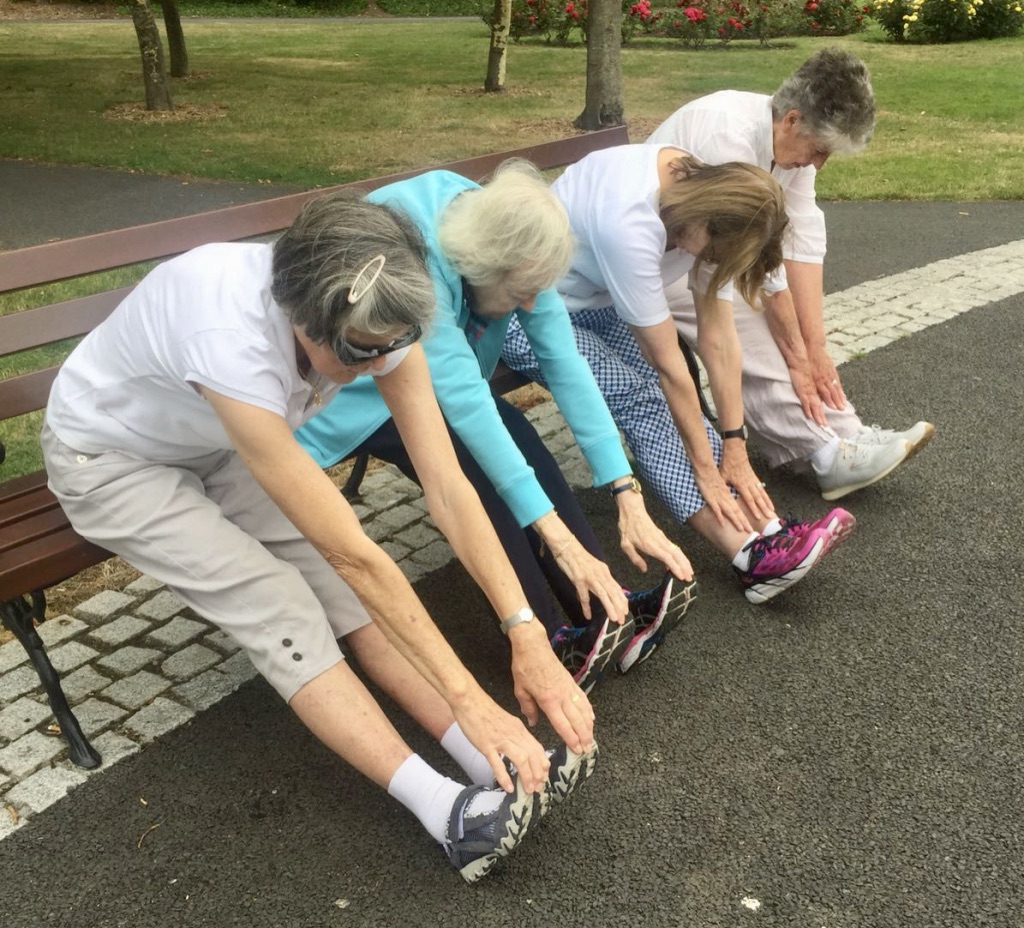
      • Stretching can help manage low back pain and arthritis, decrease falling risk, improve posture and increase energy levels. As we age our muscles and joint weaken and range of motion decreases. By stretching you can improve your flexibility, increase circulation and blood flow, and maintain or develop strength. Stress and anxiety create tight and tense muscles. Stretching helps to alleviate the built-up tenseness in your muscles.
    2. Reach for the sky!
      • Upper body and shoulder movements can help the aging process become easier and reverse muscle loss and deterioration. By lifting your arms up, you are improving your posture, relieving lower back pain, building core muscles and strengthen shoulder and back muscles. Periodically throughout the day, reach for the sky and hold for a few seconds. Too easy? Grab a can or something similar to make it more difficult. This exercise will make activities such as lifting or carrying items easier.
    3. Leg raises can do wonders!
      • Leg raises can help strengthen your thighs, hips, buttock and lower back muscles, all help with balance and stability. Since leg raises are done in both a sitting and standing position, they are easy to do at any time. To keep your joints moving to add these to your daily routine. Since they are so simple and convenient, the exercise will not interrupt your day-to-day activities. Balancing is essential in helping flexibility and fall prevention.

    Keep it low impact. Modifying these movements and exercises is the key to a successful routine. Low impact means less strain on the body. Exercises can be done standing or sitting, if standing is too difficult, sitting down can still produce impressive results. With the implementation of these three exercises in your daily life, you will live better and balanced. Let us know if you tried any of our tips for exercise for older women.

    Why not try an exercise class near you!

    ***Disclaimer: The information in this post is for reference only and is not intended to be a substitute for medical expertise or advice. If you have any concerns about your own or another’s health then please contact your doctor. 

  • Stand Up To Falls

    Stand Up To Falls

    This weeks blog post was written by one of our senior physical trainers, Shane. He has outlined a few fantastic exercises to help with fall prevention.

    In the last year I have challenged myself to make clients and class participants stand more. When I looked into the increasingly important topic of falls prevention I soon realised how little time many of my older clients actually spend standing or using everyday situations to help prevent falls. Let’s take a standard arm curl exercise. By performing the action in a standing position instead of in a seated position a person can simultaneously work on balance and stability through engaging the core. This weight bearing task in a standing position can help give the confidence to better perform everyday tasks in the home.

    It’s not just a case of performing exercises while standing that is of relevance but the nature of the exercises being performed. Leg strengthening and static balance can be a great starting point in building confidence. For example, one can start with exercises such as heel raises or leg curls. Static balance like in the picture below will also help balance and stability – positions such as a one leg stance where one foot is raised off the floor and held with no hand support. This can be done while standing near a counter if confidence is lacking. However, we must increasingly look towards exercises that challenge cognitive function and encompass movements that are multidirectional within our exercise programmes.

    (One leg stance – static balance)

    When we tackle falls prevention we must not look at elements of our body and movement in isolation but rather the entire process. When working on a current falls prevention programme with my colleagues – which will be coming soon to Siel Bleu Ireland – we took our visual, vestibular and somatosensory systems into account in addition to looking at leg strength and multidirectional cognitive challenges.

    We can look at one aspect of falls prevention which may at first seem insignificant – toe strength. Toe strength is the best predictor of falls within the elderly. Mickle et al. (1) discovered non falling older adults have 20% more toe strength over those who fall, while no differences were found between ankle and quadriceps strength. A movement I have been using to gauge toe strength and counter this problem with clients and class participants is the Vele Forward Lean Manoeuvre, as prescribed by Thomas Micahud and illustrated below. This movement teaches strength in a position that commonly leads to falls when we lean or shift forward to reach for an object, or on the initiation of walking. Using this one aspect of falls prevention, we soon realise how something so small can have such a huge part to play in the overall fight against falls. Of course, toe strength alone will not be sufficient to prevent falls, we must look again at all patterns of movement and systems involved.

    (Lean forward using only your toe strength and hold the position, press toes into floor and pause for up to 5 seconds in end range. Return to vertical position again pressing toes hard into the floor.  The hips and torso should be straight and don’t allow heels to lift off the floor. Perform this exercise up to 20 times daily and introduce weight bearing as you build confidence)


    We must ask ourselves if we have ever practised lateral, backwards, or cross over stepping movements or reinforced our ability to move in different directions and deal with a potential loss of balance.  Current theory suggests we have an increased reliance on stepping as a strategy to deal with falls (2) but do we have motor memory of performing such movements? Falls prevention should prepare us to deal with the unexpected before it happens, whereas too often we only think about falls prevention after a fall has occurred or when balance becomes a real problem.

    We must literally stand up and exercise to fight falls prevention! Seated and static exercises that don’t stimulate us aren’t sufficient to challenge falls prevention as we age. We must think about movements that are functional in dealing with everyday challenges and in different environments.  We must practise movements that make us think and makes us step in different directions. We must think about our walking stride, agility and our ability to judge obstacles in the street. Stand up, move and stay strong!


    1.Mickle, K, et al., ISB Clinical Biomechanics Award 2009: Toe weakness and deformity increase the risk of falls in older people. Clinical Biomechanics 2009;24:787-79

    2.Lateral Stability and Falls in Older People Mark W. Rogers and Marie-Laure Mille Department of Physical Therapy and Human Movement Sciences, Feinberg School of Medicine, Northwestern University, Chicago, Illinois

  • Managing Arthritis Through Exercise

    Managing Arthritis Through Exercise

    World Arthritis Day – The importance of exercise to manage Arthritis.


    What is arthritis?

    Arthritis is the terminology used to describe inflammation of the joints. There are approximately 915,000 people living with arthritis in Ireland. While there are 100 types of arthritis, the most common are Osteoarthritis which is caused by the sea and tear of cartilage that protects the joints and rheumatoid arthritis which is a long term autoimmune disorder which causes painful and swollen joints.

    Arthritis is the leading cause of disability in Ireland, accounting for one in three GP visits and costs the exchequer €700million per year in lost earnings and forced retirement, according to Arthritis Ireland. While there is no known cure for arthritis, there are multiple ways to help deal with the effects.

    Regular physical activity can have a a tremendous effects on people living with arthritis, specifically when it comes to reducing pain and helping to maintain mobility. It is probably the best thing that you can take charge of to help with the condition. The current World Health Organisation recommends 150 minutes of exercise per week for people aged 65+, however it can be difficult for people living with arthritis to meet this guideline due to complications with the condition.

    When it comes to arthritis, even a little exercise can be beneficial. A resent study from Northwestern University Feinberg School of Medicine in Chicago tested the effects of exercise for people with Osteoarthritis affecting one knee. Results showed that people who engaged in longer sessions of physical activity were more likely to have greater physical abilities, however, people who reached just 45 minutes as opposed to the 150 minute per week guideline, are 80 per centre more likely to maintain or improve their physical abilities than those who only exercised from under 45 minutes.

    But what type of exercise can do you with arthritis? While exercise is really one of the best medicines for arthritis many people are afraid to do any type of physical activity for fear of exacerbating the condition. We recommend speaking to your doctor to get advice on the best type of exercise for you. At Siel Bleu we also offer physical activity classes for people with arthritis, led by our professional physical trainers. If you would like to join our class in Killiney or to set up a class for you Arthritis support group call 01 209 6889.

  • 7 Common Excuses You Say To Avoid Exercising

    7 Common Excuses You Say To Avoid Exercising

    Image result for lazy to exercise cartoon

    How you should respond the next time someone comes up with an excuse.

    As part of our series to encourage people to start exercising, today we are tackling the common excuses we hear from people to not exercise and we give you some guidance to help overcome those excuses.

    Everyone including myself has this misconception that exercise means hitting the gym and lifting 20KG weights to be labelled as fit and healthy. That’s actually not true (Unless you’re an athlete). But we’re just normal people leading a normal lifestyle. Therefore, exercise can seem intimidating, especially as an older adult if you’ve never done it before.

    The Oxford English dictionary defines exercise as “activity requiring physical effort, carried out to sustain or improve health and fitness.” Did you notice that it didn’t state you have to run strenuously or sweat a bucket? Exercise can be used to improve your wellbeing or even to improve a part of your body that might need some TLC. For instance, if a person keeps falling, balancing exercises such as heel raises are considered a form of exercise.
    Exercise also improves your sleeping pattern. I personally feel that I sleep much better and feel less tired the following morning when I exercise regularly. It makes me feel good about myself and makes my day better. In a previous post, we discussed taking the first steps to start exercising. Now that we know exercise isn’t as scary, let’s get into the common excuses we hear to avoid exercising.

    1. I am too old
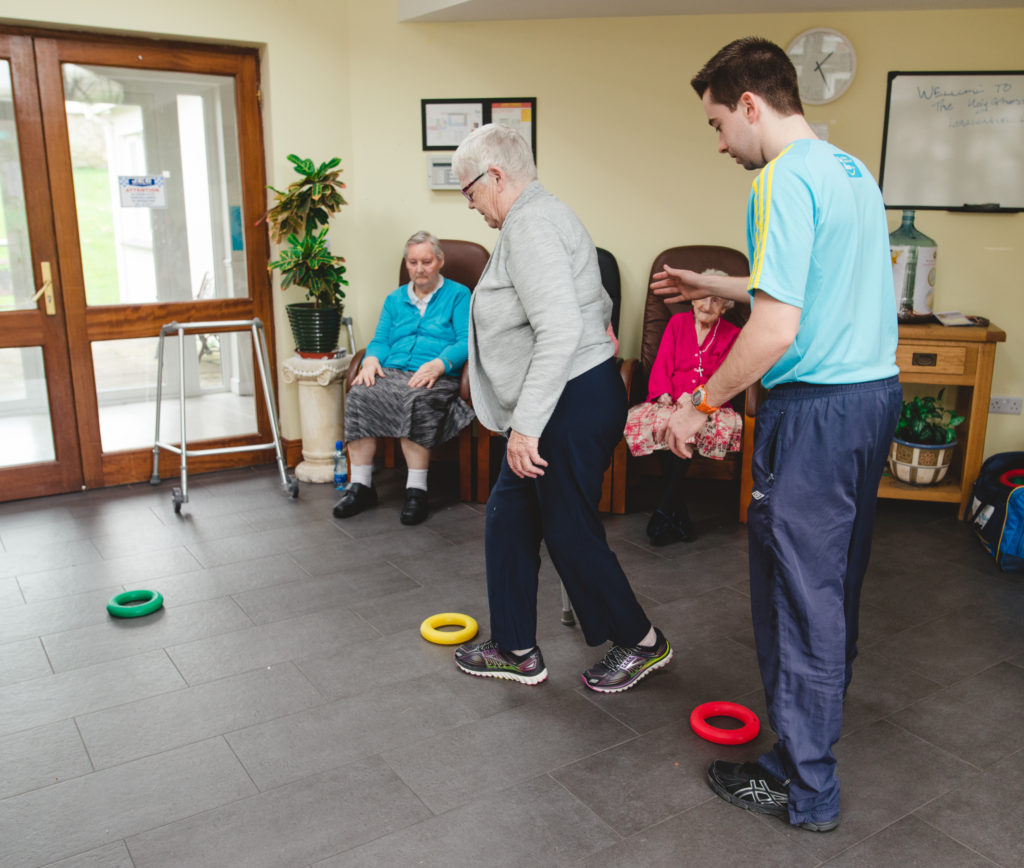
    Well, there are many studies saying that it is never too late to exercise. It may be hard to start exercising especially if you haven’t done it since you were young. So be it then. You do not have to start like a professional athlete. You can start by doing a chair exercise at home like our “At Home Guide” or go for a walk. Try a Siel Bleu community exercise class or see if there is an aqua fit class in your local swimming pool.

    2. I am afraid I will fall and I’m too unhealthy
    You might be afraid that you will fall when you exercise. Believe it or not, exercise actually does the opposite. It helps strengthen your muscle preventing you from falling. However, it is important to realise that this is all specific kinds of exercise that focus on certain part of the muscle that prevents falling and thus it is important to seek help from a professional, like a Siel Bleu Physical Trainer before carrying out any activity. If you’re worried about falling during a class, seek a programme designed by professionals who will ensure to reduce falling hazards as much as possible. And you are never unhealthy to exercise. Everyone needs to start somewhere to be healthy. Everyone has to start somewhere.

    3. I am too lazy
    We all have that day when we just don’t feel like doing anything and not feel guilty about it, or is it just me? During those days, I would usually just watch the telly the entire day and let’s not forget snacks. So to make my days slightly productive, during commercial breaks I would move around and exercise for 4 minutes. Let say a show lasts for an hour and I watch the telly for 10 hours. And there is 4 commercial in every show. That will amount to 160 minutes of exercise. Now that’s not exactly realistic, but even moving during the break will help to reduce the time you are sedentary and improve your help. Simple exercises that can be done at home such include leg extensions and heel raises when you’re on the couch.

    4. I have arthritis
    “I should avoid moving too much” is the most common misconception about arthritis. Instead, you should move regularly because it keeps your muscle and the tissue surrounding the joints, therefore, protecting the bones, which prevents joint pain from getting worse. Exercise also lubricates your joints for ease of movement. It helps to maintain a healthy body weight which will reduce the stress on your joints. Your doctor, physiotherapist or Siel Bleu Trainer will be more than happy to show you the different kind of exercises to alleviate your pain.

    5. I have back pain
    Back pain is typically caused by a weak core. Exercise is the best way to strengthen your core. Stretches and the correct resistance work can help elevate the back pain. Having a back pain shouldn’t stop you from exercising, provided you’re doing the right exercises. If the pain is really bad, it is best that you seek medical attention.

    6. I have diabetes
    I think the biggest concern for people living with diabetes is the drop in their blood sugar level. I do not have diabetes but there are times when I over exercise, I would feel a little light headed. I realise that it is important to pace my exercise and listen to your body. Bring a small snack like an apple or some juice. Sit down when if you feel light headed. Do not panic. Breathe through it and have a sip of your juice or sweet snack. It is better to have someone with you when you exercise or let someone know where you will be. You might want to link your location to your family’s phone so that they can track your location. Consult your doctor before carrying out an exercise and they will advise the right programme for you.

    7. I have COPD
    Why would anyone with COPD who already has shortness of breath exercise? That’s going to make your breathing more laboured than usual. Well, that’s where the misconception comes in. It is actually recommended to exercise if you have COPD because exercising will increase the heart rate, which will make the blood circulate carrying more oxygen around the body.

    To conclude, don’t be afraid to exercise again. Observe yourself and take note. If you realise that you exercise better in the morning than in the evening, take note. Or you have better balance when you wear your pink shoe instead of the green one, mark that down. Little difference can change your attitude towards exercise. I

    **DISCLAIMER – Please always consult with your GP before making any changes to your lifestyle.

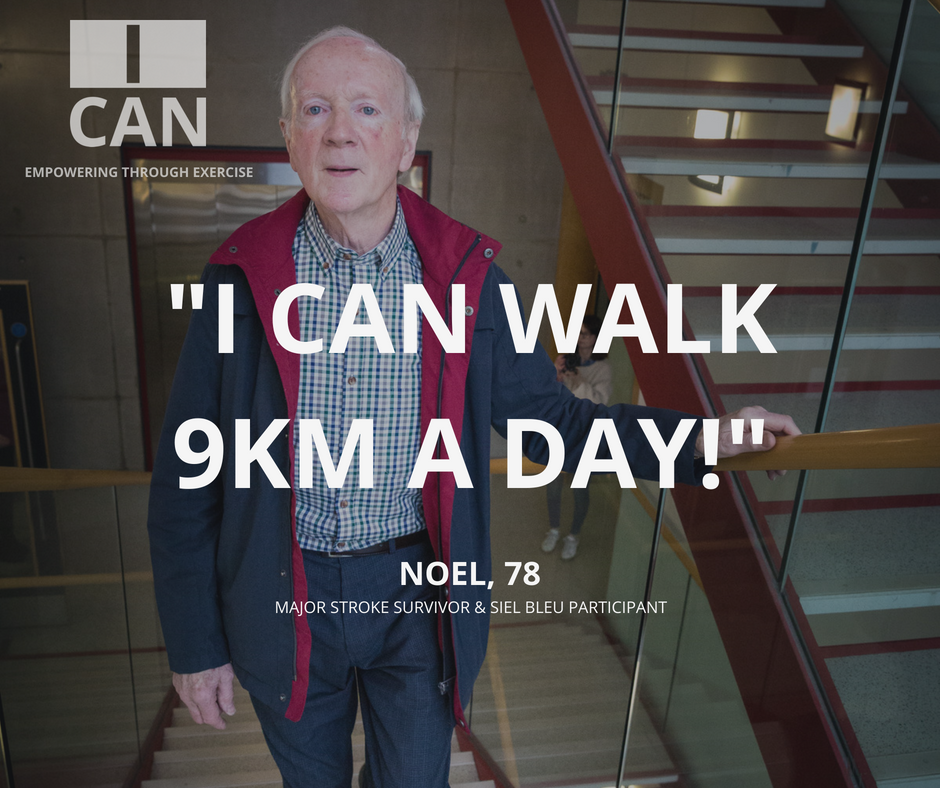
  • I Can Campaign – Empowering Through Exercise – Noel Can Walk 9km a Day!

    I Can Campaign – Empowering Through Exercise – Noel Can Walk 9km a Day!

    Today I Can, maybe tomorrow You Can too!

    Today marks the first day of Siel Bleu’s first awareness week “I Can” Empowering Older Adults Through Exercise.

    We know exercise is one of the most important things for our lives, and today we want Ireland to understand how important it is for older adults and adults living with chronic disease. For these cohorts, exercise has many benefits, including physical, social and psychological, but there is also empowerment. Exercise has the ability to help older people and people living with chronic conditions to take charge of their own health and empower them to do things they may have believed they weren’t able to do anymore.

    Over the next 5 days we will be showcasing the incredible people who have successfully debunked the myth that just because you are older or living with an illness you can’t exercise.

    Siel Bleu, Siel Bleu Ireland, Exercise for seniors, Exercise for older adults, Balance exercise programmes, Workout for seniors, Activity for the elderly, Exercise for old people, Elderly activity, Elderly fitness, COPD workout, Exercise for COPD, Chair exercise routine, Siel Blue, Fitness programme for seniors, Stroke workout

    After working for decades as an electrician, Tallaght man Noel, 78, was looking forward to a slower pace of life upon his retirement. Unfortunately, his health didn’t allow for it. After only one year of retirement, Noel was diagnosed with prostate cancer. He was successfully treated for it, however more health issues were waiting around the corner.

    Noel suffered ten mini-strokes and one major one that they caught in time. The strokes caused a hormonal imbalance for Noel resulting in mood swings; he called himself a “contrary bugger.” There were times where all he wanted to do was to sleep and he was hit with multiple waves of emotion each week, causing him to cry uncontrollably.


    Siel Bleu, Siel Bleu Ireland, Exercise for seniors, Exercise for older adults, Balance exercise programmes, Workout for seniors, Activity for the elderly, Exercise for old people, Elderly activity, Elderly fitness, COPD workout, Exercise for COPD, Chair exercise routine, Siel Blue, Fitness programme for seniors, Stroke workout


    Noel signed up for Siel Bleu’s Stroke Survivor class in Tallaght, and never looked back. The programme helped to aid his physical and emotional recovery with the help of his peers in the group. The physical exercise each week encouraged Noel to continue working out throughout the week, and he now goes for a 9km walk everyday. Noel’s emotional symptoms have significantly reduced and he feels like the exercise class is one of the best things to have happened to him.


    Would you like to join the I Can movement and discover what you CAN do?

    Why not check out our website and follow us on Facebook and Twitter!


  • Breathing – Techniques to Bring More Calmness to the Body!

    Breathing – Techniques to Bring More Calmness to the Body!

    Our bodies are designed to live 110 years. Yet as we reach our mature (and more wiser) years of life, we begin to slow down and almost accept our decline. It’s widely known that as we age we begin to experience more ‘wear and tear’, ‘clicking’ in our joints and a loss in bone/muscle mass. However, to combat this or prevent the speediness of these chronic issues, it is advised that we move more and sit less! However the most important thing we can do as you as humans.. breathing.. is often overlooked and underemphasized.

    Consider the foundations that are laid when building a house. If they are laid incorrectly, there will be problems down the road. Our bodies are the same. If we constantly breathe poorly and put ourselves into compromised positions, we begin to crumble, similar to the bricks of that house.

    Dysfunctional breathing is defined as chronic or recurrent changes in breathing pattern that cannot be attributed to a specific medical diagnosis, causing respiratory and non-respiratory complaints. This is not a disease but it can be associated with pulmonary illnesses such as COPD and heart problems. In long term cases, it can have potential negative effects with mind and muscles, mood, metabolism, chronic fatigue, fibromyalgia and mental health. To name a few…

    Trust me, the majority of clients that I see for the first time have lost touch with breathing. Don’t believe me? test yourself…

    Place one hand on your chest and the other hand on your stomach. Now, take a deep breath in through your nose and slowly exhale out through your mouth. Did both hands move as you breathe in? Or did the hand on your chest move more than the one on your stomach?  If so, we need to address that. Breathing from our chest is what is known as thoracic breathing. This abnormal breathing pattern is greater upper chest breathing and upper rib cage motion in comparison to the lower rib cage (1). It has been found to cause hypertension in the muscles associated with breathing (2), particularly upper back and neck muscles, where the majority of us feel most of our tension.  It also prevents the diaphragm from returning to its resting position, which goes on to challenge trunk stability, leading to more muscular imbalances upstream and downstream in the body. Moreover, breathing in this heightened manner is often associated with our sympathetic nervous system (think ‘fight or flight’). This type of arousal is where the body is in a state of stress and releases adrenaline which tricks the body into thinking it is under a heightened workload and triggers an increase in heart rate, constriction of blood vessels and muscular tightness. So basically this is us in survival mode and prevents efficient relaxation and stress management.

    sympathetic nervous system, parasympathetic nervous system


    To deal with this, we need to reconnect to our parasympathetic nervous system (think ‘rest or digest’). A way of promoting this is via diaphragmatic breathing. Diaphragmatic or normal breathing is synchronized motion of the upper rib cage, lower rib cage and abdomen (3). Ok so let’s put it into practise.

    Experimenting with breathing: While lying down (can also be performed in a chair), breathe in through your nose, filling your abdomen with air three-dimensionally (meaning belly, obliques & low back). Exhale through slightly pursed lips by using your gentle pelvic floor, transverse abdominis and obliques to press the air out. Breathing through pursed lips also helps to restore diaphragmatic function.

    diaphragmatic breathing, breathing stretches


    Core Work: Try raising your knees so that they are vertical to your hip and back is flat on the floor. Hold this position for 5-10 seconds. This will give you better dynamic neuromuscular control (postural respiratory pattern).

    Hugging Knees: Focus on breathing into the entire rib cage, allowing the abdomen to expand slightly. Avoid shallow breathing into the upper chest and shoulders.

    diaphragmatic breathing, breathing stretches


    These exercises can be used to gain more awareness of diaphragmatic breathing.  If you still aren’t convinced about the benefits of reconfiguring our breathing pattern or want to play with the idea further, look up ‘Wim Hof’. He’s a Dutch adventurer and has numerous world records, including climbing the highest mountain on earth wearing just a pair of shorts and immersing himself in an ice bath for an hour and a half while maintaining his core body temperature and preventing hypothermia. Sounds like a freak of nature, right? Yet his methods are based simply on training the way he breathes. His methodology is now raising questions on effective breathings response with autoimmune diseases and cancer research.

    As a way of preventing a collapsed diaphragm and creating trunk stability whether it be lifting something off the floor or exerising use the two-hand rule(5). All you have to do is place one thumb on your sternum with your palm facing down and place your other hand parallel to that on your pelvic floor. The key is to maintain the gap between the two during all movements. If you deviate from that by bringing your hands closer together, you will have too much rounding of the upper back. If you bring the hands further apart, you will have too much overextension. Either way falling into these spinal faults over and over again creates way too much shearing on your vertebrae which can leads to discs bulging if done consistantly over time.

    Both diaphragmatic breathing and core bracing sequence can be difficult to grasp. Ingraining it into your system will take time and effort, but stay patient. All things are difficult before they become easy.

    Thanks for reading!

    References

    1. Chaitow L, Bradley D, Gilbert C.Multidisciplinary Approaches to Breathing Pattern Disorders. London, UK: Churchill Livingstone; 2002
    2. Influences of dysfunctional respiratory mechanics on orofacial pain. Hruska RJ Jr Dent Clin North Am. 1997 Apr; 41(2):211-27.
    3. Kaminoff L. What yoga therapists should know about the anatomy of breathing. Int J Yoga Therap. (2006); 16: 67–77.
    4. Long-term effects of specific stabilizing exercises for first-episode low back pain. Hides JA, Jull GA, Richardson CA Spine (Phila Pa 1976). 2001 Jun 1; 26(11):E243-8.
    5. Starret, K. Cordoza, G (2013).Becoming a Supple Leopard. 2nd ed. United States of America: Victory Belt . 42.
     

  • The Importance of Balance

    The Importance of Balance

    By Paul Kirwan

    Balance problems are something many would say is an older person’s issue due to the high rate of falls with older, but that is not the case. Balance is an important aspect of everyone’s lives, from children learning to walk and all the way through adulthood.

    Balance problems may present in younger adults for a number of reasons including a lack of physical activity, sedentary lifestyle, muscle weakness or joint stiffness. Some medical conditions can also hinder you balance such as Stroke, Parkinson’s disease & Arthritis. This is just a small example of the types of people whose balance may need attention and shows it’s not just older adults who can be affected.

    According to the Centre for Disease Control almost one-third of adults over 65 fall each year and 1 in 10 younger adults suffer broken bones and head injuries due to falling.

    Balance is needed for almost every daily activity from getting out of the bed in the morning to walking, cooking, and cleaning. If you have balance issues you will understand the barriers that come with it. Balance problems almost always cause confidence issues which affect a person’s willingness to attempt activities which they used to find easy. This issue then becomes bigger and it’s not just about balance anymore but it’s about needing constant help to live. Needing assistance for everyday activities is taking away independence as well as quality of life and this can all be prevented with some attention towards balance.

    There are many ways in which you can test your balance to see if you are at risk of falling with the easiest being, standing on one leg and timing it. But I would recommend the 4 stage balance test which you can find here: https://www.cdc.gov/steadi/pdf/4-stage_balance_test-a.pdf

    In short this test will take you through 4 different positions which will progressively challenge your balance with stage 1 being the easiest and stage 4 being the hardest.  This test can be completed in a couple of minutes and all you need is a safe anchor point (Chair, wall or person) and a stopwatch. The idea is to hold each position for 10 seconds and to move through the stages as you progress.

    After you have assessed your balance it’s time to get working on exercises to improve it.

    Balance exercises aren’t just made up of standing on one leg and timing it as a lot of people who suffer from balance issues would find this extremely challenging. Finding the right type of exercises for your individual needs is the best way to approach it.

    You will need to focus on a number of key components of fitness such as strength, aerobic, coordination and agility. A well balanced exercise programme will give you best chance of improving your balance quickly.

    Comment below if you think a video on balance exercises would be helpful.

    References:

    https://www.cdc.gov/homeandrecreationalsafety/falls/adultfalls.html

  • Exercise for Shedders

    Exercise for Shedders

    “I never thought such simple exercises could be so effective”

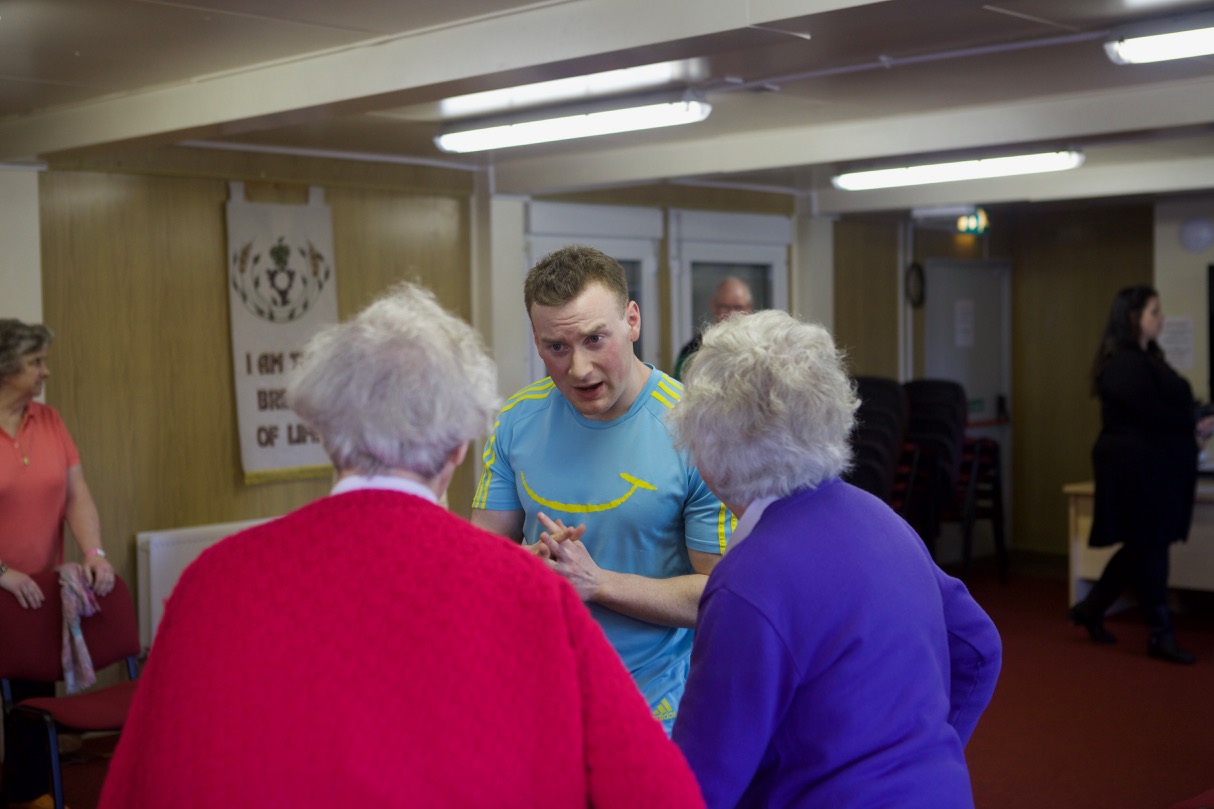
    It’s 12:30 on a Wednesday afternoon in Holywell Community Centre, Swords and twelve members of the Swords Men’s Shed have gathered for their weekly meeting. In walks Michelle in her bright blue t-shirt carrying a large equipment bag and she’s greeted with smiles and handshakes from all the men. Michelle is a qualified Siel Bleu Ireland Physical Trainer and over the course of the next hour, she will guide the men through a course of physical activity specifically designed just for them.

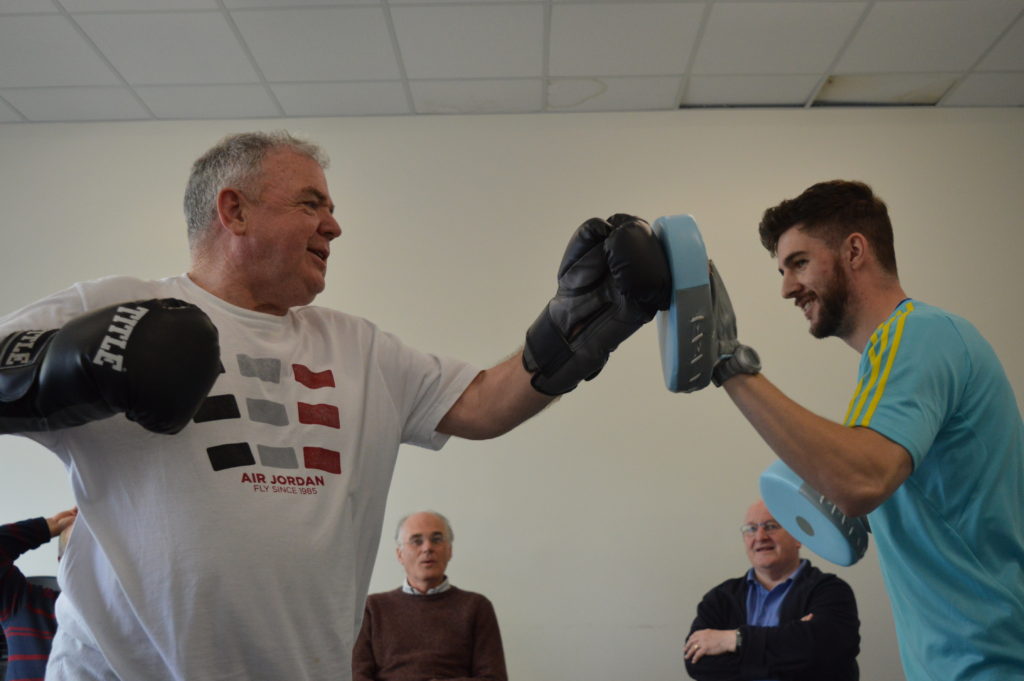
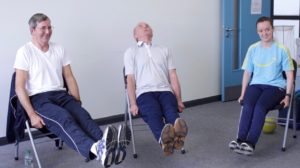
    They begin, seated in a circle, with a full body warm up from head to toe. When everyone’s warmed up, that’s when the real work starts. Based on research into the importance of physical activity for men, Michelle has designed a full body workout for the Swords Men’s Shed, with a mix of cardiovascular and resistance/strength exercises. They do squats, leg raises, shoulder presses and even some games, utilising a range of equipment exclusive to Siel Bleu.

    While there are some younger members, the group mainly comprises of men are in their 60s and the majority have retired. The World Health Organisation’s guidelines suggest that older men should undertake at least 30 minutes of exercise 5 days per week, with at least 2 of those days including resistance training for the major muscle groups. However it can be difficult for older men to gain access to exercise programmes which can be typically female focused. Our classes with the Men’s Sheds offer an avenue for men to learn about the importance of exercise and to practice physical activity with the guidance of a professional trainer in the comfort of their own shed. The programmes are simple but effective and can easily be replicated at home.

    “Before this class I did very little exercise, work seemed to take up most of my time,” says Ronnie, a member of the Swords Men’s Shed, “ Siel Bleu is very good introduction for someone who might not have a large amount of exercise experience in the past. It’s holistic in the fact that it covers a lot of areas of exercise at a pace and level that’s really enjoyable.”


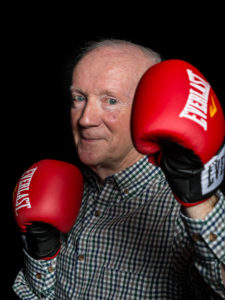
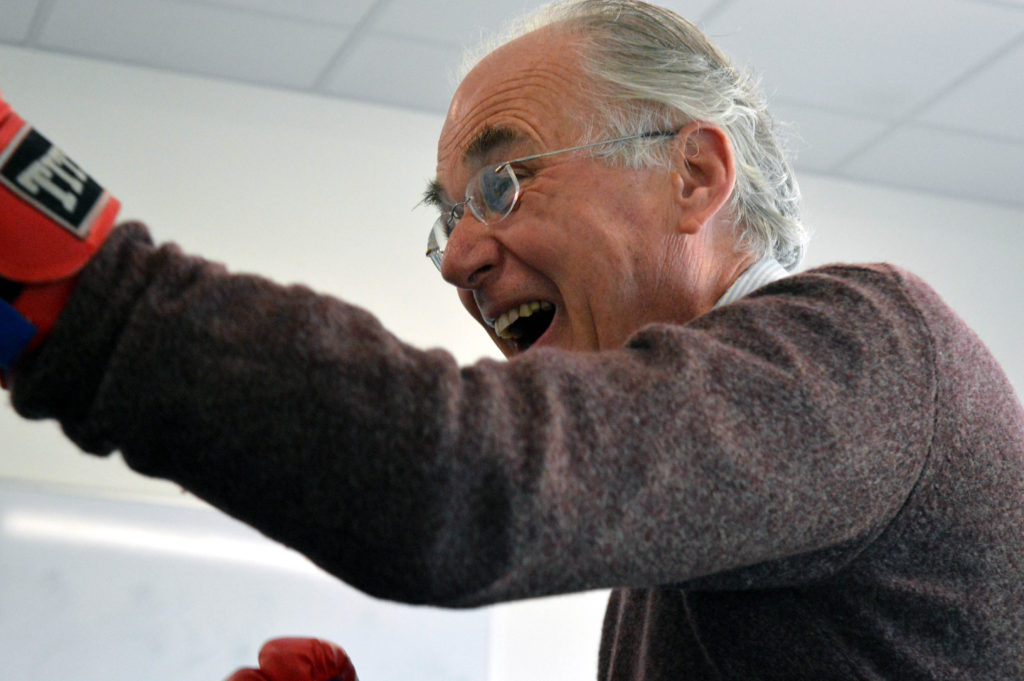
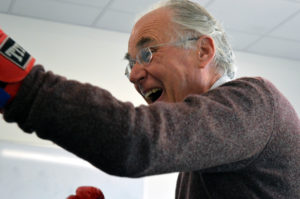
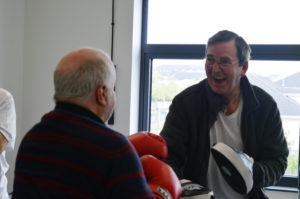
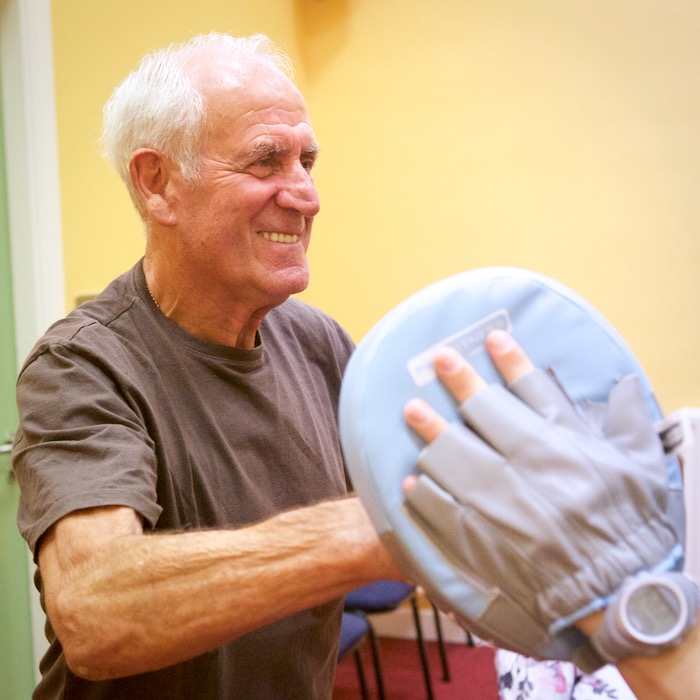
    Our physical trainers use their expertise to find activities that the participants will enjoy while being effective, such as boxing, which is very popular with the Swords Shed.

    The benefits of exercise for older men cannot be underestimated. Men who are active have lower risk of developing heart disease, stroke, type 2 diabetes, some cancers, dementia and depression which is a significant issue for men in Ireland. Through exercise, older men can retain and build muscle strength as well as improving flexibility which can all lend themselves to helping men keep their independence. While the physical benefits are important, the group camaraderie and banter has a huge impact on the men’s state of mind.

    “In the last 6 months, since I’ve started this class, I’ve seen a major change,” continued Ronnie, “Even a change in my attitude, I want to do more things, I’m better at getting up in the morning and I always look forward to the weekly exercise classes”.

    Since 2015, Siel Bleu Ireland has been partnering with The Irish Men’s Sheds Association through the Shedders for Life initiative, to make exercise accessible to the members of the sheds. Siel Bleu programmes are now available in Firhouse, Maynooth, DGK Kilkenny, Ratoath, Broomfield and Swords Men’s Sheds. To bring Siel Bleu to your Shed contact us or visit our Exercise for Shedders page.